
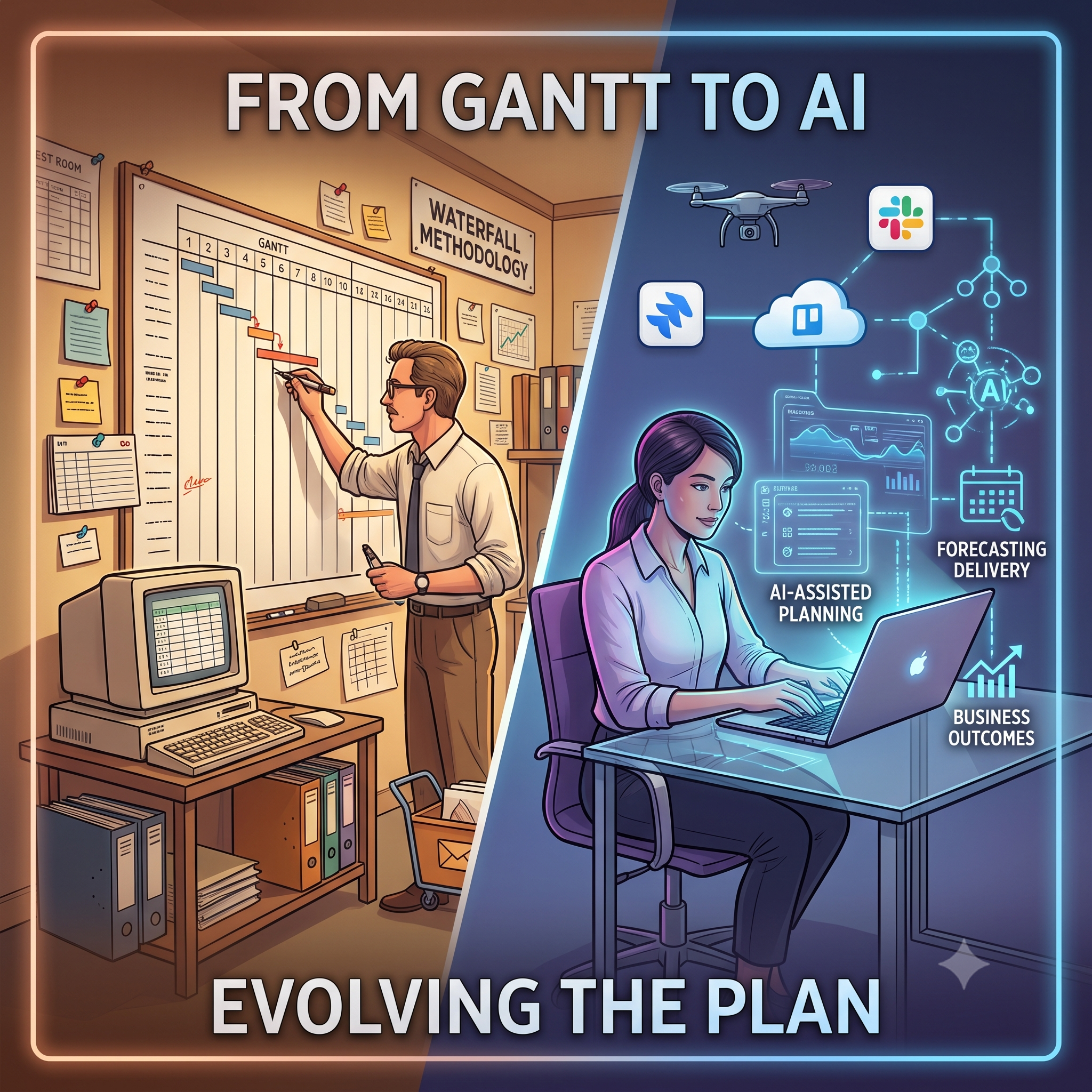

Project management has always existed in some form — the pyramids weren’t built without a plan. But the way we practice it today would be almost unrecognizable to a project manager working in 1985. Back then, PM meant paper, pushpins, and patience. Today, it means dashboards, dopamine-driven sprints, and increasingly, AI doing half the thinking for you.
Here’s a look at how the discipline has transformed over the last four decades.
The 1980s: Paper, Waterfall, and the War Room
In the 80s, project management was rigid by necessity. The dominant methodology was Waterfall — a linear, sequential approach where every phase (requirements, design, build, test, deploy) had to be fully completed before the next one began. There was no room for iteration; changing course midway through a project was expensive and often career-ending.
A few defining traits of the era:
- Gantt charts on paper or whiteboards. Project timelines were drawn by hand or with mechanical plotters. Any change meant redrawing.
- The “war room.” Physical rooms with wall-sized schedules, index cards, and pinboards were the command centers of major projects.
- Heavy documentation. Requirements were captured in binders, not backlogs. A single spec document could run hundreds of pages.
- Centralized authority. The project manager was often a singular, top-down decision-maker, closer to a foreman than a facilitator.
- Limited tooling. Software like Microsoft Project (released in 1984) was just emerging, but adoption was slow — many PMs still relied on spreadsheets or manual tracking.
- Communication lag. No email, no Slack. Status updates happened through memos, phone calls, and in-person meetings — meaning information often traveled at the speed of the internal mail cart.
The upside of this era was clarity: everyone knew the plan, and the plan rarely changed. The downside was rigidity — by the time a Waterfall project shipped, the market it was built for may have already moved on.
The 1990s–2000s: The Rise of Structure and the Seeds of Agile
As software projects grew more complex, the limitations of Waterfall became painfully clear. Projects were routinely late, over budget, or delivered something nobody wanted by the time it launched.
This period saw two parallel developments:
- Formalization of PM as a discipline. The Project Management Institute’s PMBOK Guide (first published in 1996) codified processes, and certifications like PMP became industry standards. Project management became a defined career path, not just a role someone fell into.
- The Agile rebellion. Frustration with Waterfall’s rigidity led a group of software developers to publish the Agile Manifesto in 2001, prioritizing working software, customer collaboration, and responding to change over rigid plans and documentation. Scrum, Kanban, and Extreme Programming (XP) emerged as practical frameworks for putting Agile values into practice.
Tooling also matured — Microsoft Project became a staple, and early web-based collaboration tools began replacing physical war rooms.
The 2010s: Agile Goes Mainstream, Tools Get Smarter
By the 2010s, Agile wasn’t just for software teams — it had spread into marketing, product design, operations, and beyond. Sprint planning, daily standups, retrospectives, and backlogs became standard vocabulary far outside engineering departments.
This decade also brought the tools that most PMs today grew up on:
- Jira and Trello made backlogs and Kanban boards digital and visual.
- Slack (launched 2013) killed the status-update email chain.
- Cloud-based collaboration (Google Docs, Confluence) replaced binders and shared drives.
- Hybrid methodologies emerged, blending Waterfall’s structure with Agile’s flexibility — especially useful in regulated industries like finance and healthcare, where compliance still demands documentation but delivery needs to stay iterative.
Remote and distributed teams also became more common, pushing PMs to get comfortable managing across time zones, not just across a hallway.
Today: Data, Automation, and AI-Augmented Delivery
Modern project management looks less like scheduling and more like orchestration. A few shifts define the current landscape:
- Real-time dashboards replace static status reports. Tools like Jira, Asana, Monday.com, and Linear surface burndown charts, velocity, and blockers instantly.
- AI-assisted planning. PMs now use AI to draft user stories, forecast delivery risk, summarize meetings, and even flag scope creep before it derails a sprint — work that used to consume hours of manual synthesis.
- Hybrid and async-first delivery. With distributed teams the norm, more coordination happens asynchronously through documented decisions rather than live meetings.
- Outcome over output. Where 80s PM measured success by “did we finish the plan,” today’s PM increasingly measures success by business outcomes — did the feature move the metric it was built for.
- Continuous delivery. Instead of a single big launch, most modern teams ship incrementally, sometimes multiple times a day, blurring the line between “building” and “running” a product.
The role itself has shifted too. A modern project or delivery manager isn’t just tracking tasks — they’re facilitating cross-functional collaboration, managing stakeholder expectations, and increasingly acting as a bridge between technical teams and business strategy, especially in industries like fintech where compliance, speed, and trust all have to coexist.
What Hasn’t Changed
For all the tooling and methodology shifts, some fundamentals remain the same as they were in the 80s:
- Clear communication still wins projects.
- Scope, time, and budget are still in constant tension.
- People, not tools, deliver projects — software just removes friction.
The war room is gone, replaced by a dashboard. But the core job — turning ambiguity into a plan people can actually execute — hasn’t changed at all. What’s changed is how much faster, and how much smarter, we can now do it.

One response to “From Gantt Charts to AI: How Project Management Has Evolved Since the 80s”
Hi, this is a comment.
To get started with moderating, editing, and deleting comments, please visit the Comments screen in the dashboard.
Commenter avatars come from Gravatar.