
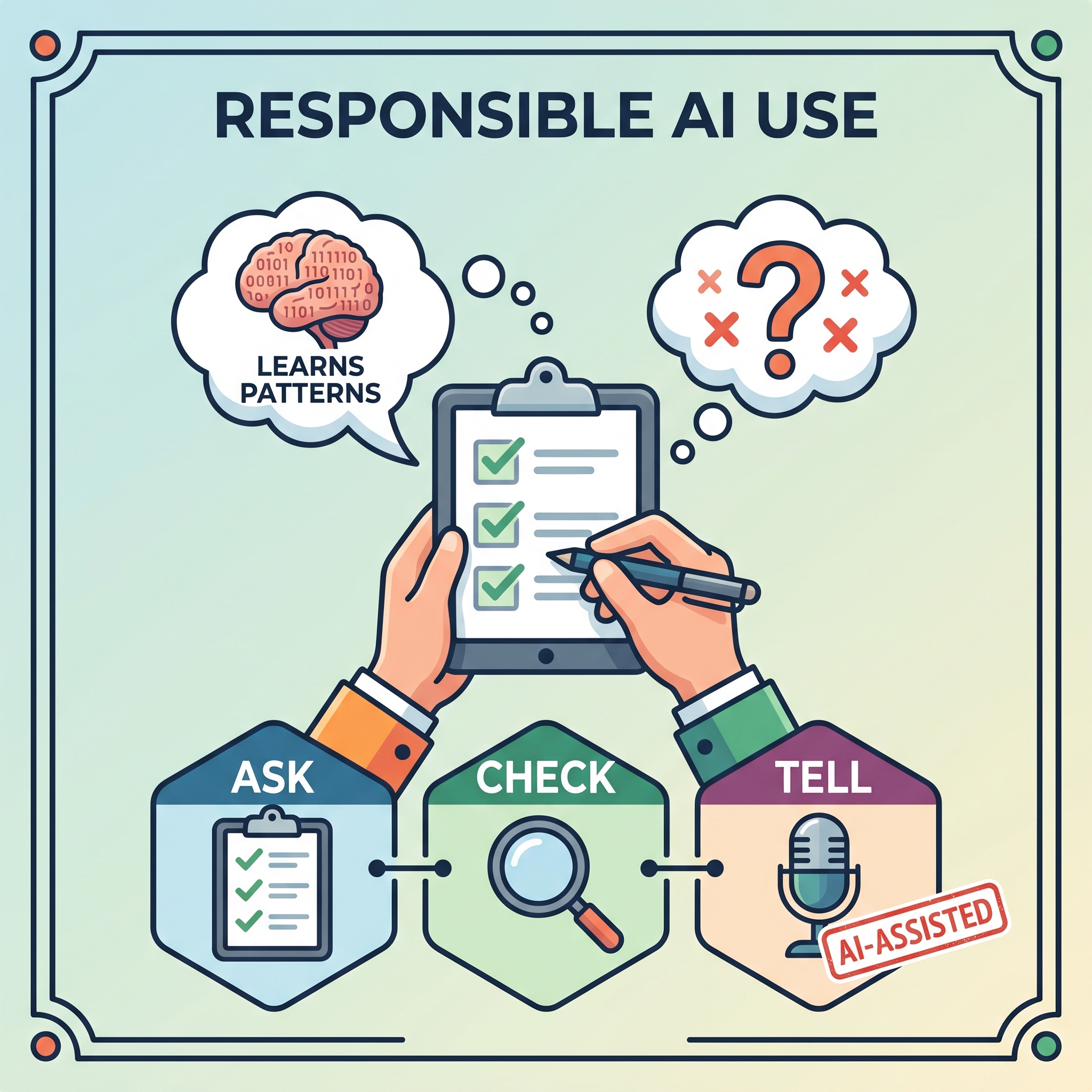

Artificial Intelligence has revolutionized how we brainstorm, write, and solve problems. But as powerful as these tools are, they aren’t foolproof. To get the best out of AI—without falling into common traps—we need to stay actively engaged in the process.
Here is how to navigate AI responsibly using the ACT Framework and a human-first mindset.
The Reality of AI Limitations
Before putting full trust in AI outputs, it’s vital to remember two core limitations:
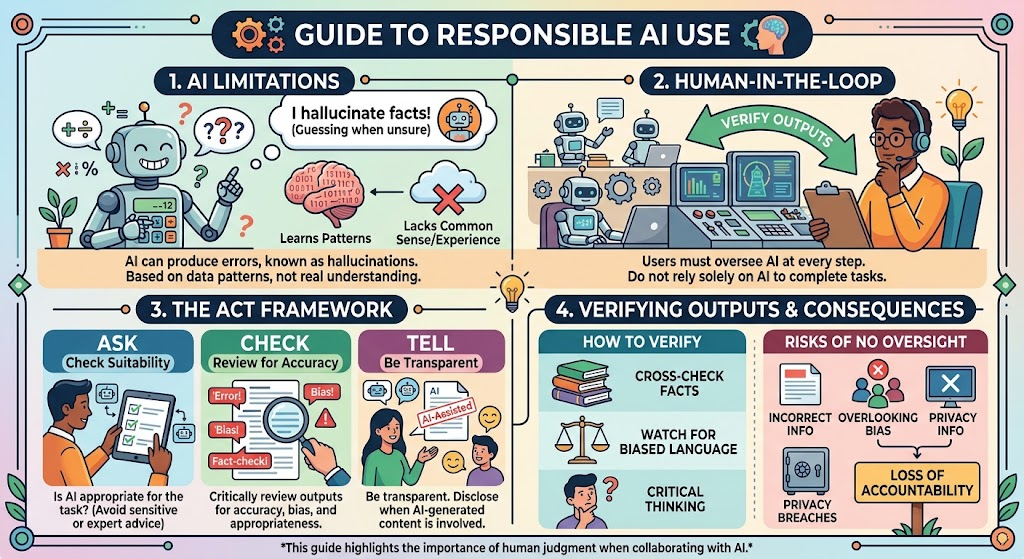
- AI Hallucinations: AI can confidently generate completely false or incorrect information. This usually stems from errors in its training data or when it encounters unfamiliar prompts.
- Lack of Common Sense: AI doesn’t “know” the world through experience—it simply predicts patterns based on data. It doesn’t possess real-world judgment or human intuition.
Because AI is essentially making calculated guesses, relying on it blindly can lead to spread of misinformation, unexamined bias, or privacy risks.
Staying Responsible: The ACT Framework
To keep yourself firmly as the “human-in-the-loop,” apply the ACT Framework whenever you interact with AI:
| Step | Action | Practical Application |
| Ask | Assess Appropriateness | Before starting, ask if AI is right for this task. Avoid plugging in sensitive, confidential, or high-stakes professional queries without expert oversight. |
| Check | Critically Review | Never take outputs at face value. Fact-check claims against trusted sources and scan for subtle biases, structural errors, or loaded language. |
| Tell | Maintain Transparency | Be upfront. Disclose when AI has been used to assist, generate, or shape the content you share with others. |
You Are the Final Safety Net
AI is an incredible co-pilot, but you are still the pilot. AI cannot take accountability for mistakes, privacy breaches, or biased outcomes—only you can.
By practicing active critical thinking, verifying facts, and practicing transparency, you can leverage the speed of AI while maintaining the standards, ethics, and accuracy that only human judgment can provide.